
Darajani market in the morning
Stone Town's main market is loud, crowded and alive with colour. Go early, before the heat, and come with patience and a few Swahili words.
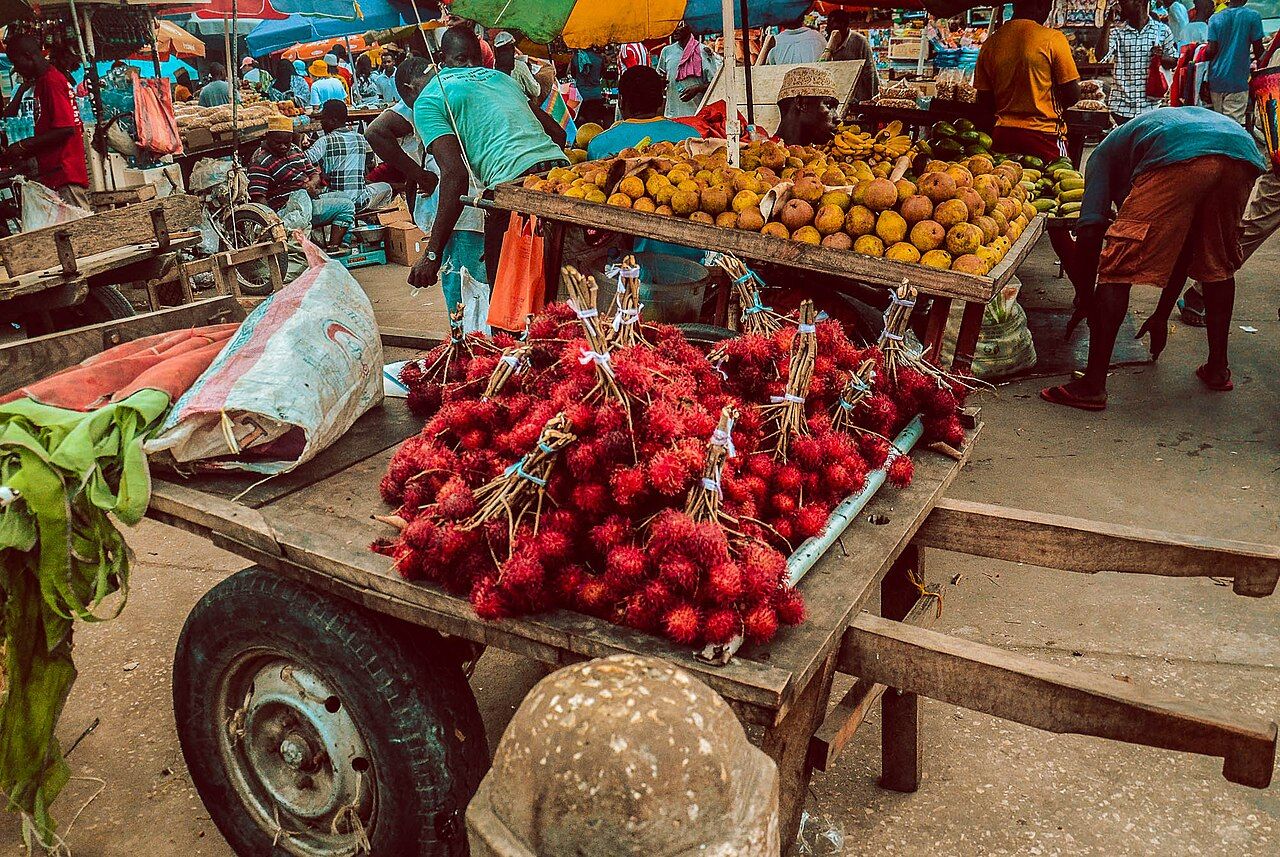 Picture: Erasmus Kamugisha · Creative Commons BY-SA 4.0 (source file)
- From Stone Town
- On the edge of Stone Town
- Pace
- Easy
- Getting there
- Walk to Darajani Road, inland edge
- Bring
- Small notes, a cloth bag, closed shoes
Darajani market sits on the inland edge of Stone Town, where the old quarter meets the newer town beyond. Its name comes from daraja, the Swahili word for bridge, recalling the bridge that once crossed the creek separating the two halves of the city. Locals often call it Marikiti Kuu, the main market. It is where much of the town shops for food every day, and visiting in the morning is one of the best ways to see ordinary life on the island.
The market building and the halls
At the heart of the market is a long stone building with a tiled roof and a small tower, built in the early twentieth century. Around it, the market spills out into covered halls, open-air stalls, side streets and shaded alleys. The layout is loosely divided by what is sold, though stalls drift into each other.
 Picture: Erasmus Kamugisha · Creative Commons BY-SA 4.0 (source file)

Fish
The fish hall is busiest in the morning, when catches arrive from boats along the coast. You will see tuna, kingfish, snapper, small reef fish, squid and octopus, sometimes sold by auction with fast and loud bidding. The floor is wet and slippery, the smell is strong and the noise is constant, so wear closed shoes.
Meat
The meat section, with beef, goat and chicken, is not for the squeamish. Carcasses hang in the open and are cut to order. If you prefer to skip it, the fruit and spice stalls are a short walk away.
Fruit and vegetables
The fruit stalls are the most colourful part of the market. Depending on the season you may find mangoes, pineapples, papaya, small sweet bananas, jackfruit, passion fruit, oranges and limes. Red, hairy rambutans, known locally as shokishoki, appear in season and are worth trying. The durian, with its powerful smell, is another seasonal visitor that divides opinion.
Spices
Spice stalls sell cloves, cinnamon, cardamom, nutmeg, black pepper, turmeric and ready-made mixes for pilau and curry. Some are aimed at visitors and sell pretty packets at higher prices; others serve local cooks with loose spices sold by weight. Look for whole spices that smell strongly and have not been sitting in the sun.
The daladala stand
Across the road from the market is the main stand for daladalas, the minibuses and converted trucks that serve as public transport across Unguja. They leave for destinations all over the island, and the stand is a whirl of shouted routes, revving engines and passengers squeezing in. Riding one is a cheap and memorable way to reach places like the east coast or the north, though it is slow and crowded.
Routes and fares change, so ask at the stand which vehicle you need, and confirm with the driver or conductor before getting in. Keep your bag on your lap and your valuables out of sight in the crush.
Pair it with Clove, nutmeg and cinnamon: the spice island
Fish at first light
Morning is the time. Arrive between early morning and late morning, when the fish has just come in, the fruit is fresh and the heat has not yet built up. By early afternoon the market quietens and the best produce has gone. Fridays around midday can be quieter, as many traders go to prayer.
During Ramadan, the market rhythm changes. Mornings may be slower, and the busiest time can shift to late afternoon, when people shop for the evening meal that breaks the fast.
Bargaining politely
Bargaining is normal for many things in the market, but it is a conversation, not a battle. Some tips:
- Greet first. A jambo or habari before you ask a price sets a good tone.
- Ask the price, then make a reasonable offer. For food, prices are often fixed or close to it; for spices and souvenirs, there is more room.
- Keep it light. Smile, and be ready to walk away pleasantly if you cannot agree.
- Know when to stop. A small difference matters more to the seller than to you.
- Carry small notes. Change for large notes can be hard to find.
Learning a few Swahili numbers and the word bei (price) can earn a laugh and sometimes a better deal. Asante (thank you) works everywhere.
Photographs and manners
The market is a working place, not a show. Many traders and shoppers do not want to be photographed, and some will be annoyed if a camera is pointed at them without asking. Ask first, accept a refusal, and consider buying something from a stall you want to photograph. Wide shots of the market building and produce are usually less intrusive than close-ups of people.
Dress modestly, as in the rest of Stone Town, with shoulders and knees covered. Keep bags in front of you in crowded areas; pickpocketing is not common but can happen anywhere busy.
Beyond the market
Darajani is a good starting point for a walk. From the market, head west into the lanes of the old town, or south towards the cathedral at the former slave market. If you want to understand the spices more deeply, a half-day at one of the island's spice farms shows how the plants grow. And for ideas on what to do with everything you buy, see eating on the island.
Many visitors find that a slow loop of an hour or so is enough for a first look, with a pause for a cup of spiced tea or a fresh coconut on the edge of the market. Come back on a second morning if you can. The market feels different once you know your way round, and the stallholders may even remember you.
With photos by Adam Jones from Kelowna, BC, Canada · Creative Commons BY-SA 2.0 (source file); Eric Kilby · Creative Commons BY-SA 2.0 (source file); Harvey Barrison from Massapequa, NY, USA · Creative Commons BY-SA 2.0 (source file)


